

Reviewed by Megan Reznik, DDS, MS
Almost nobody’s teeth come in perfectly. A bad bite, which dentistry calls malocclusion, can make chewing harder, make teeth harder to clean, affect speech, and wear specific teeth down faster than the rest. Below are the problems orthodontists see most often and how to correct each one.
Bite problems come from a mix of causes: inheritance, thumb sucking, dental disease, poor hygiene, accidents, birth defects or other medical conditions. Knowing which one you or your child has is what an examination is for.
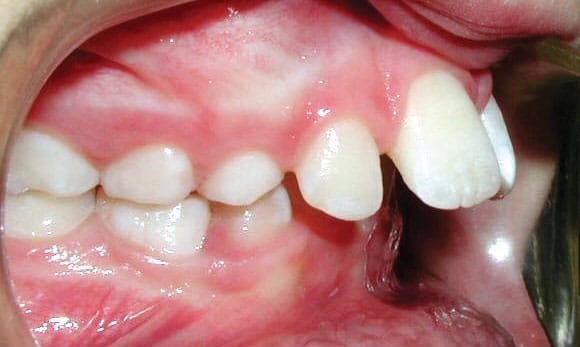
Upper Front Teeth Protrusion
The upper front teeth extend too far forward, or the lower teeth not far enough. It affects how the teeth work and how they look, and leaves the front teeth exposed to being chipped in an accident.
Usually corrected with braces or aligners. In a growing child, jaw growth can sometimes be guided to help.
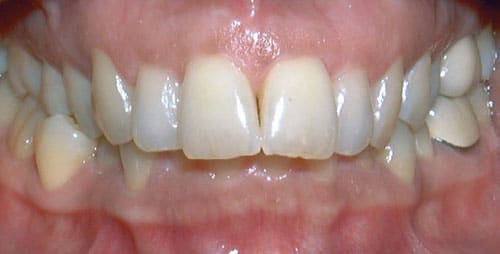
Overbite
The upper front teeth cover too much of the lower front teeth when the mouth is closed. In a deep overbite the lower teeth can bite into the roof of the mouth.
Corrected with braces or aligners, sometimes with elastics to change the jaw relationship, and in severe adult cases with surgical orthodontics.
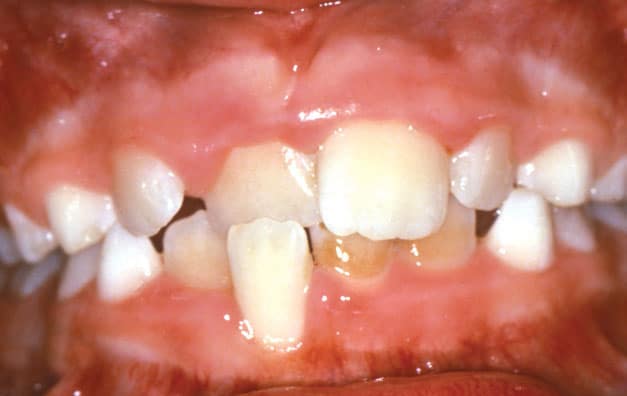
Crossbite
The upper teeth sit inside the lower teeth, on one side or across the front. Left alone it can wear teeth unevenly and push the jaw to grow off-center.
Often corrected with expansion, particularly in children, alongside braces or aligners. This is one of the strongest arguments for an early check.
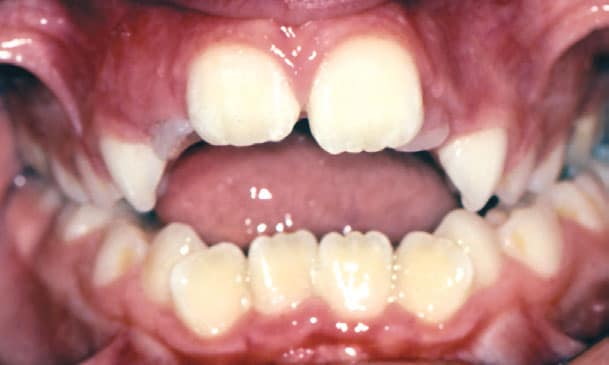
Open bite
The upper and lower front teeth do not overlap or meet at all, so biting into food happens on the back teeth. Open bites are frequently linked to habits such as thumb sucking or tongue thrusting, and correcting the habit is usually part of correcting the bite.
Treated with braces or aligners, appliances that address the habit, and in some adult cases with surgery.
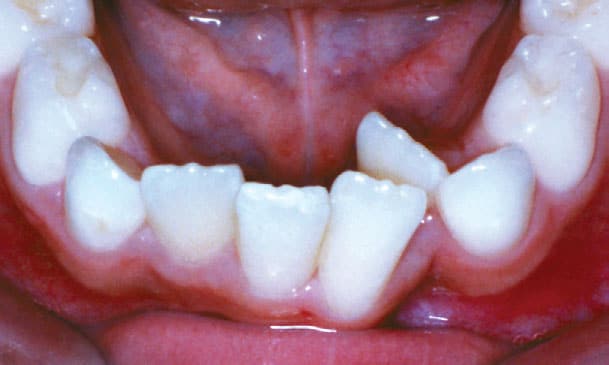
Crowding
There is not enough room in the arch for the teeth to come in straight, so they overlap and rotate. Crowded teeth are harder to clean, which is why crowding tends to bring decay and gum problems along with it.
Crowding can often be corrected by expansion, and in many cases tooth removal can be avoided altogether. Which route applies depends on how much space is missing and on whether the patient is still growing.
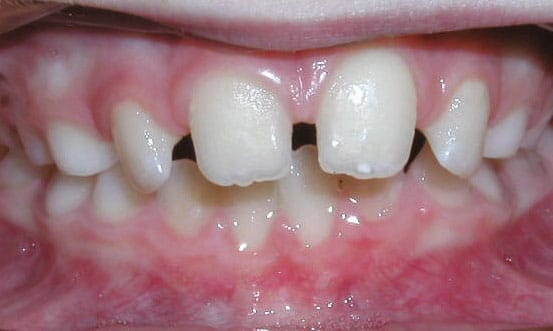
Spacing
Gaps between the teeth, either from missing teeth or simply from the teeth being smaller than the arch that holds them. Sometimes purely cosmetic, sometimes not.
Closed with braces or aligners. Where a tooth is genuinely missing, orthodontic treatment may be used to open or hold space for a replacement instead of closing the gap.
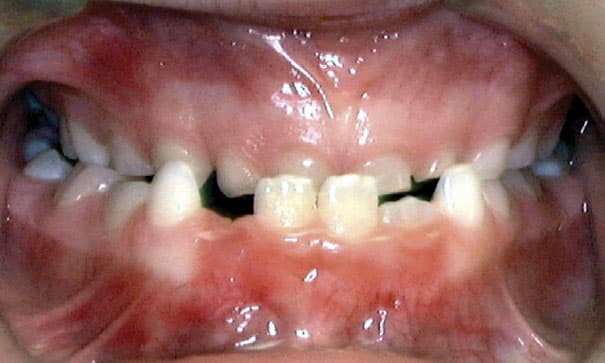
Underbite
The lower jaw extends forward, so the lower front teeth sit in front of the upper. This is the bite problem most likely to be skeletal rather than dental, which is why timing matters with it.
In a growing child it can often be guided with orthodontic appliances. Once growth is finished, a significant underbite usually needs surgery combined with orthodontic treatment.
When to have it looked at
The American Association of Orthodontists recommends a first orthodontic check by age 7. That is early enough to catch the problems that are far easier to fix while the jaw is still growing, particularly crossbites, underbites and severe crowding.
For adults there is no deadline. See adult orthodontics, or complex cases and retreatment if you have had braces before and something has come back.
How these get diagnosed
Most of the conditions above can be seen in the mouth, but seeing one is not the same as understanding it. A crossbite can be dental or skeletal, and the two are corrected differently. Crowding can be a space problem or a size problem. An open bite may be structural, or the result of a habit that is still active.
That is what the records are for. Study models, X-rays, and three-dimensional imaging where the case calls for it show where roots actually sit, how the jaws relate, and whether a permanent tooth is heading somewhere it should not. The plan follows from that rather than from the appearance.
Find out what you are dealing with
Call the Odessa office at (432) 333-7105 or the Midland office at (432) 682-1222, or request an appointment online.
Dr. Megan Reznik and Dr. Derek Reznik are each a Diplomate of the American Board of Orthodontics. The consultation is free, and it ends with a name for the problem, a plan and a fee. What treatment costs is on the cost and financing page.
Frequently Asked Questions
What is the difference between an overbite and an overjet?
Overbite describes how much the upper front teeth cover the lower ones vertically. Overjet describes how far forward the upper front teeth sit horizontally. People usually mean overjet when they say a tooth “sticks out”, and the two are treated differently.
Does an untreated bite problem get worse?
It usually does not correct itself, and several of these conditions worsen over time. Crowding tends to increase with age, and a crossbite left untreated during the growth period can influence how the jaw develops.
Are these problems always visible?
No. Crowding and protrusion are obvious; a crossbite at the back of the mouth or a developing jaw discrepancy often is not. That is exactly why a child gets checked at 7 rather than when something starts to look wrong.
Can one person have more than one of these?
Frequently, and most treatment plans address more than one thing at once. Crowding with a deep bite is a very common pairing. The examination sorts out which problem drives the others.