
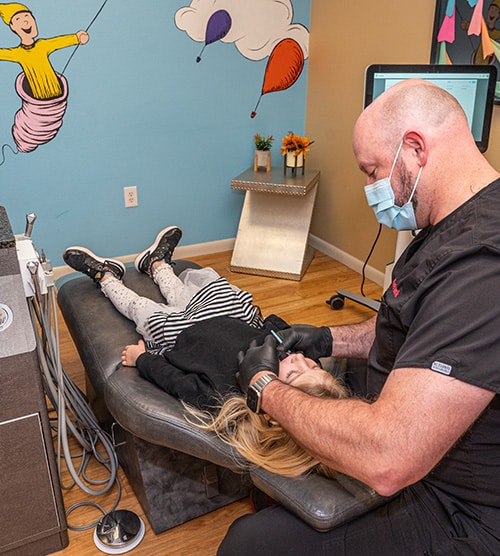
The American Association of Orthodontists recommends a first orthodontic check by age 7. Most children who are checked at 7 do not need treatment then, but the check is what tells you whether they will, and when. Reznik Orthodontics sees children at both its Odessa and Midland offices, and the first visit is free.
Age 7 sounds early, and the reason has nothing to do with straightening teeth early. By 7, enough permanent teeth have come in and enough jaw growth has happened that an orthodontist can see the shape of what is coming: whether there will be room, whether the bite is developing correctly, whether a habit is pushing teeth where they should not go.
Some of those problems are far easier to fix while a child is still growing. A few are only easy then. That is the argument for an early check, and it is not an argument for early braces.
What actually happens at the first visit
The doctor examines your child’s teeth, jaws and bite, takes the records needed to see what is happening under the gums, and then tells you one of three things: nothing needs to be done now or later; nothing needs to be done yet; or something is better done now.
The middle answer is the most common. The picture is incomplete because the permanent teeth are not all in, so your child goes onto the orthodontic supervisory program and comes back periodically.
A smaller group has a problem that is genuinely easier and cheaper to correct at 8 than at 13, and those cases start a first phase. You get that answer at a free consultation, not after a paid workup.
The orthodontic supervisory program
Children who are not ready for treatment go on recall, and the program costs nothing.
They are seen roughly every 6 to 8 months so the doctors can watch permanent teeth come in and catch problems while they are small. Sometimes a poorly erupting permanent tooth is resolved simply by removing a stubborn baby tooth. Your general dentist is notified of anything recommended along the way.
The program aims to find the best time to start, which affects how long a child spends in braces more than almost anything else.
What early treatment can do while a child is still growing
When early treatment is indicated, it can:
- Guide erupting permanent teeth into better positions
- Preserve space for permanent teeth still to come
- Regulate the width of the upper and lower arches
- Reduce the chance of fracturing front teeth that stick out
- Lower the risk of a permanent tooth becoming impacted
- Reduce the need for permanent tooth extractions later
Help correct thumb sucking and tongue or swallowing habits that affect the bite
Early treatment does not usually eliminate braces later. What it typically does is make the comprehensive phase in the teenage years shorter and more straightforward, because the structural work is already done. Occasionally further treatment turns out not to be needed, but that is an outcome rather than a promise.
Early treatment does not benefit every child
Many orthodontic problems are corrected more easily in the teen years, once every permanent tooth is in, and some skeletal problems should not be touched until growth is further along or finished. Treating a child early who did not need it early means more time in appliances for the same result.
Working out which child is which is the actual value of the age-7 check, and it is a specialist’s judgment. A practice that puts every seven year old into an appliance is not exercising it.
Orthodontist, pediatric dentist, or both?
A pediatric dentist and an orthodontist do different jobs.
- A pediatric dentist specializes in treating children: cleanings, fillings, sealants, and getting an anxious four-year-old comfortable in a chair. Your child should have one, and should keep seeing them right through orthodontic treatment, since braces make teeth harder to clean.
- An orthodontist is a dentist who completed two to three additional years of full-time specialty residency in tooth movement and jaw development, and treats nothing else. There is no separate specialty called “pediatric orthodontist”; an orthodontist who treats children is simply an orthodontist.
Dr. Megan Reznik and Dr. Derek Reznik are each a Diplomate of the American Board of Orthodontics, meaning each has:
- Passed the board’s written examination
- Submitted treated cases from their own practice for review
- Defended those cases before a panel of examiners
It’s a voluntary process an orthodontist undergoes. See board certification.
Signs worth an earlier look
Book a check before 7 if you notice any of these:
- Baby teeth lost very early or very late
- Difficulty chewing or biting
- Mouth breathing, or persistent thumb or finger sucking past about age 5
- Teeth that do not meet properly, or do not meet at all
- A jaw that shifts to one side when your child bites down
- Crowded, blocked-out or clearly protruding front teeth
- Speech difficulty that your dentist links to tooth or jaw position
Your dentist may spot several of these first and send you over. A referral is not required either way.
What a first phase involves
Where early treatment is indicated, it’s usually a limited course with a specific job rather than a full set of braces.
- Expander: widens a narrow upper jaw, the usual answer to a crossbite, and often creates enough room to avoid removing permanent teeth later.
- Partial braces: align a few specific teeth.
- Space maintainer: holds room open where a baby tooth came out early.
- Habit appliance: addresses thumb sucking or tongue thrusting.
Which one applies depends entirely on what the examination finds.
Phases are short by design, followed by a period of watching while the remaining permanent teeth arrive. Visits during a first phase fall 4 to 8 weeks apart and run 20 to 40 minutes, the same as any other course of treatment.
Parents are welcome in the room throughout, and for a first visit it’s better if you’re there, since half the questions are yours.
Bring any recent X-rays your dentist has taken, since those can often be used instead of repeating them.
Book your child's free check
Call the Odessa office at (432) 333-7105 or the Midland office at (432) 682-1222, or request an appointment online.
If your child needs nothing, you will be told that and put on the no-fee monitoring program so the right moment is not missed. If treatment is due, you get the plan, the timeline and the fee in the same visit. See cost and financing.
Frequently Asked Questions
My child still has most of their baby teeth. Is a check pointless?
No, and that is the point of doing it at 7 rather than 12. Enough permanent teeth and jaw growth are present by then to predict what is coming, while there is still growth left to work with.
What is the "rule of 7" people mention?
Shorthand for the age-7 first-check recommendation. It does not mean braces at 7. It means a first evaluation at 7.
Will an early phase mean my child avoids braces as a teenager?
Usually not. Early treatment fixes the structural problem while growth can help, which shortens the braces phase later rather than replacing it.
Are appliances uncomfortable for a young child?
There is an adjustment period of a few days, and children adapt faster than adults expect. Soreness after a fitting is normal and short. Anything sharp, loose or genuinely painful is a reason to call.
How often will we come in during an early phase of treatment?
Roughly every 4 to 8 weeks, and appointments run 20 to 40 minutes. Siblings can be booked back to back so one trip covers both.